
What Executives Need to Acknowledge First in a Job Search
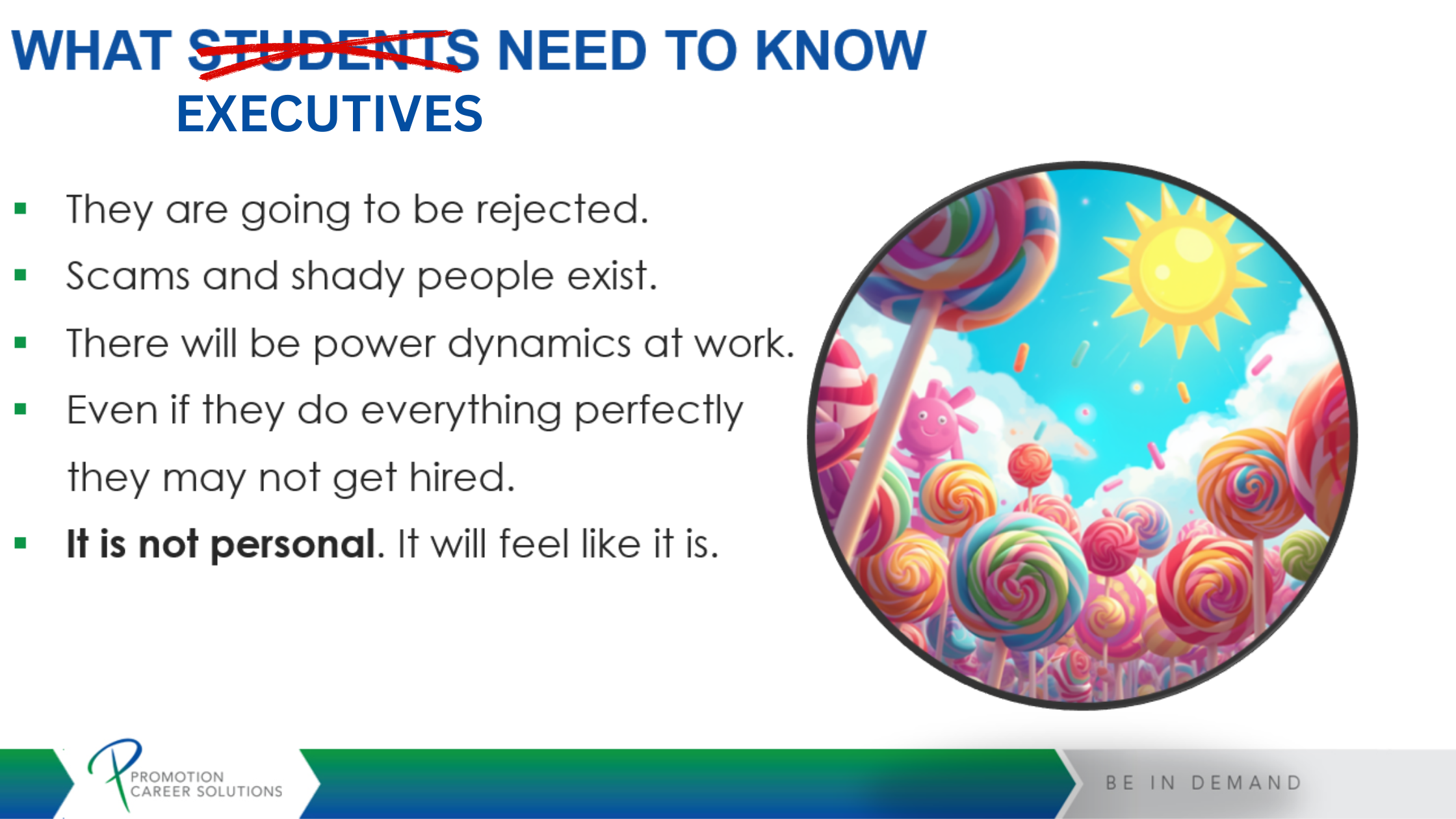
When I was invited to speak to teachers about preparing students for the workforce, I didn’t start with résumés. I didn’t start with LinkedIn. I didn’t start with networking.
I started with reality.
Whether you’re 17 entering the workforce or a seasoned executive navigating a complex transition, the fundamentals don’t change much. What changes is how high the stakes feel and how quietly these truths operate at senior levels.
Here’s what I told them. And what I remind executives every day.
You will face rejection
At the executive level, rejection just gets more sophisticated. It’s less likely to be a blunt “no” and more likely to be silence, a stalled process or a role that “evolves” out from under you. You may be a strong candidate and still not get the offer.
Not every opportunity is what it seems
Young professionals are warned about scams. Executives encounter a different version: misrepresented mandates, internal candidates disguised as open searches, or roles that exist more for optics than intent. Due diligence isn’t just for acquisitions.
Power dynamics are always in play
At senior levels, hiring is rarely just about capability. It’s about alignment, influence, internal politics, succession planning, and risk tolerance. You’re being assessed not only on what you’ve done, but on how you fit into a broader, often unspoken agenda.
You can do everything “right” and still not get the role
This is the one that unsettles even the most accomplished leaders. You tailored your story. You built relationships. You interviewed well. And still, no offer.
Because hiring decisions are not made in a vacuum. Timing, internal shifts, budget constraints, and competing priorities all influence outcomes. The best candidate and the hired candidate are not always the same person.
It’s not personal; even when it feels like it is
This is the hardest one to internalize. At an executive level, your identity is often tightly woven into your work. So when opportunities don’t materialize, it can feel like a verdict on your worth.
It rarely is. One search, one decision, one organization’s internal calculus – none of that defines you. The executive who understands this moves faster, recovers better, and stays in the game longer.
Why this matters before you start your search
Too many executives begin their job search focused on tactics: updating their résumé, refreshing LinkedIn, reaching out to contacts. All necessary, but not sufficient.
Without a grounded understanding of how the market actually operates, even the best strategy becomes fragile. Starting here helps you:
- Reduce emotional whiplash when the process stalls
- Sharpen decision-making under uncertainty
- Build resilience without sliding into cynicism
- Engage strategically, not reactively
The shift that changes everything
When you accept these realities, your approach changes. You stop chasing every opportunity and start assessing fit more critically. You stop measuring progress by offer counts and start measuring it by the quality of conversations you’re having and the alignment you’re building.
That’s when a job search becomes less about landing any role and more about finding the right one.
The teachers I spoke with understood immediately why this slide came first. If we don’t prepare people for the truth of the process, we set them up to fail. And for executives, failure isn’t just costly in time, it erodes the confidence and momentum that the next chapter depends on.
Before the résumé. Before the outreach. Before the interviews.
Start with reality.
Related Categories: Advice, Featured, Job Search, Students & Parents
About The Author
Maureen McCann is an award-winning career coach, master resume writer, and master certified interview, employment, and career strategist whose clients include C-level executives, managers, and professionals in all industries including the Canadian banking, oil and gas, healthcare, IT, and government sectors.